We believe that everybody, not just those who are working in research or in academia should have access to research data and other research processes. While it has been gaining traction in the past years, the full appreciation and practice of Open Science is still very much to be desired.
What is open science?
Open Science is the practice of science in such a way that others can collaborate and contribute, where research data, lab notes and other research processes are freely available, under terms that enable reuse, redistribution and reproduction of the research and its underlying data and methods.
Why Open Science?
The world of publishing still uses a classic publication model, where for example (academic) articles are placed behind a paywall that can only be accessed by subscribers. Individual articles in humanities and social sciences can be individually downloaded for 30-100 USD. This is a vicious cycle that in most cases rich universities make their research accessible only to other rich universities.
Open Science advocates for FAIR (Findable, Accessible, Interoperable and Re-usable) data and open data sharing. It should become the default for the results of EU-funded scientific research. The ultimate goal of FAIR is to optimise the reuse of data. To achieve this, metadata and data should be well-described so that they can be replicated and/or combined in different settings. Published materials are free to access and read online.
In this section, we will publish more information about Open Science, how this will benefit everyone, as well as making research outputs from students, academics, researchers and practitioners more visible and accessible.
Development Around the World (DAW) Journal, Volume 1 (2024)
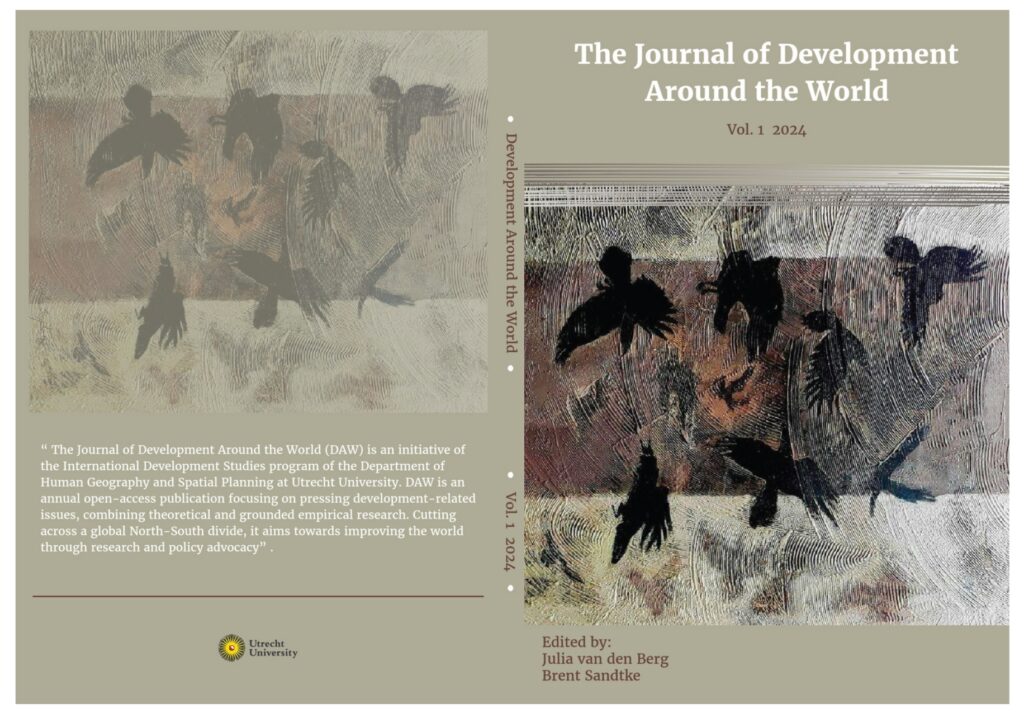
This new journal, initiated by the International Development Studies (IDS) community of Utrecht University, highlights significant contribution of students, researchers and practitioners to research and knowledge-sharing by comprehensively examining contemporary challenges and opportunities.
The collective findings of The Journal of Development Around the World (DAW) are drawn from various case studies from fieldworks around the globe, address pressing concerns from the field, including issues like socio-environmental impacts, foodscape transformations, and climate change adaptation.
The foundation was built over 15 years ago as a series of separate booklets and will now be published as an official open-access journal. Since the publication of the first booklet ‘Development Mosaics’ (2008), titles have varied from Exploring Development (2009) to Development Around the World (2010, 2011, 2013) and finally, Development in a Glance, a Journey through a Changing World (2014). It is an excellent moment to thank all the editors of earlier work, which have laid a firm foundation for the new journal: Vera Brok and Evianne Moret (2008)– Marloes van den Berg, Dennis van Buren, Lena Katzmarski, and Maarten van Schoten (2009); Ina Arnaoudova, Eileen Dyer, Elen Papaopoulou and Peter Verhagen (2010); Stephanie Anderson-Morales, Jolanda van Ginkel, Tim Daniel Krap and Renske van Milink (2011); Bregje van Stipdonk, Evans Kirigia and Murtah Read (2013); Lotte-Marie Brouwer, Sacha Handgraaf, Romy Santpoort and Margherita Scazza (2014).
In DAW, the editors and authors address the contemporary concept of development that encompasses the multidimensional progress of livelihoods and stretches beyond economic growth by including social equality, environmental sustainability, and technological advancements. It underlines inclusivity, fosters human well-being, and addresses inequality. The various contributions – based on fieldwork in various parts of the world – help understand the link between an increasingly complex world and daily life – and the multiple perspectives that co-exist between regions and generations. This journal aims to continue to uphold those objectives of linking flows, transitions, and transformations in and between the local, regional, and global societies and generations that foster the development discourses.
“Valuable studies conducted by students, consultants, or practitioners disappear under the radar as grey literature with much of the collected empirical material being lost; with communities often seen as objects, not as experts by experience or potential readers. By presenting this knowledge in the form of accessible articles, we can make a valuable contribution to debates and policymaking on many relevant development topics currently in the spotlight. Especially in these times of misinformation and fake news, knowledge of the local situations – and looking at reality from different perspectives – is of great importance.” – Dr. Prof. Annelies Zoomers, IDS, Utrecht University
By presenting this knowledge in the form of accessible articles, students, researchers, and writers in this journal make a valuable contribution to debates and policymaking on many relevant development topics currently in the spotlight. Especially in these times of misinformation and fake news, knowledge of the local situations – and looking at reality from different perspectives – is of great importance.
The journal is free to read and can be downloaded from this link.
Development Around the World (DAW) Journal, Volume 2 (2025)
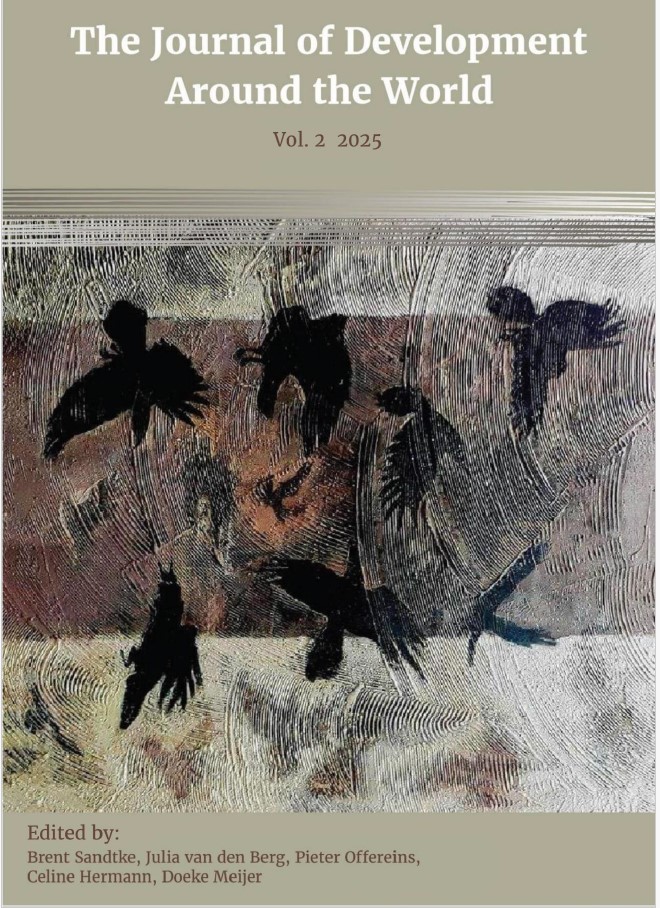
As debates over global development intensify, the need for critical, context-specific engagement has never been more pressing. As editors of Development Around the World, we invite readers to consider the intricate interplay of political, social, cultural, and ecological factors that shape prospects for more equitable and resilient futures. The chapters in this volume do not aim to provide universal solutions or quick fixes. Rather, they call for attentiveness to local circumstances, recognition of diverse forms of knowledge, and an understanding that individuals and communities—despite significant constraints—exercise meaningful agency in shaping their own lives.
The second volume of Development Around the World (DAW) offers a diverse range of studies addressing urgent questions in contemporary development. These contributions engage with the complexities and nuances of global challenges, demonstrating how individuals, communities, and institutions navigate and negotiate development processes in various settings. Across its chapters, this volume underscore’s themes of inclusion, resilience, sustainability, and justice, providing a foundation for critical reflection and informed action among scholars, practitioners, and policymakers.
The volume opens with H. Osman’s “The Role of Social Networks in the Integration of Eritrean Migrants in the Netherlands.” This chapter illuminates how Eritrean migrants draw on informal networks to adapt, integrate, and find belonging in an unfamiliar environment. By revealing how these connections complement and sometimes compensate for formal institutional support, Osman highlights the vital role of interpersonal relationships in shaping migration experiences.
Marta Martínez Fabiani’s chapter, “Women’s Non-Migrant Livelihoods in the Sundarbans: Intersecting Challenges and Opportunities in a Changing Social-Ecological System,” turns our attention to the resourcefulness and agency of women in an ecologically fragile region. Fabiani’s research challenges stereotypes of passivity, illustrating that women are central to household and community resilience amidst environmental and socio-economic change.
In “Influence of Mining Operations on Quality of Life of Local Communities: A Case Study of Extensive Open-Pit Mining in Chingola, Zambia,” Mathijs van Baarle critically examines the socio-economic and environmental effects of large-scale mining operations. His analysis reveals the tensions between economic gain and broader social and environmental costs, underscoring the importance of equitable governance and sustainable resource management for just developmental outcomes.
Céline Londoño Hermann’s “From Advocacy to Action: Understanding the Role of NGOs in Promoting Safe Abortion Services in Northern Ghana” explores how non-governmental organizations navigate complex socio-cultural environments to improve reproductive health services. By focusing on community engagement, Hermann illustrates how advocacy and local participation can transform health systems, enhancing equity and well-being.
Mélanie Rechnitzer’s contribution, “Changing Food Practices: Exploring the Dynamics of Social Practices for Sustainable Food Innovations in Cotonou’s Food System Lab,” delves into the emergence of sustainable food initiatives at the intersection of tradition and innovation. Her examination of community-led adaptations offers crucial lessons for policymakers, advocating for approaches to food governance that foster resilience and sustainability in urban contexts.
In “Sowing Seeds of Understanding: Epistemic Justice in the Co-Creation of Nature-Based Solutions,” Thirza Vos makes a compelling case for inclusive environmental governance. Demonstrating that the effectiveness of nature-based solutions hinges on incorporating diverse knowledge systems, Vos argues for co-creative practices that ensure epistemic justice, thereby strengthening both ecological outcomes and community ownership.
Finally, Spyridon Kafetzopoulos’s “Home in Transition: Exploring Self-Settlement Pathways and Emplacement of Refugees and Asylum Seekers” examines how displaced populations negotiate notions of home amid ongoing mobility and uncertainty. Kafetzopoulos’s study displays the resilience and creativity of refugees and asylum seekers, challenging static notions of identity and belonging and providing insights into the lived realities of displacement.
Collectively, these chapters present a rich tapestry of perspectives on the complexities and interconnected dimensions of development. They traverse issues ranging from migration and resource governance to food systems, health equity, and environmental justice. Together, they emphasize the necessity of inclusive, context-sensitive approaches in realizing more sustainable and just outcomes.
The journal can be accessed free and can be downloaded here.